

Scope of Article 32 – How far can courts go in refusing relief?
Introduction
Recently, the Supreme Court in United Voice For Education Forum vs Union Of India fined Rs 1 lakh on the petitioner seeking to reopen the 2014 constitutional bench ruling that exempted minority institutions from the Right To Education Act under Article 32. This raises a fundamental question: since rights under Article 32 are fundamental, is refusing to remedy them under this provision constitutional? To find out, we must first understand the meaning and intent of Article 32.
Article 32 – Letter and Spirit
By just focusing only on the sections we care about, Article 32 gives “the right to move the Supreme Court by appropriate proceedings for the enforcement of the rights conferred by this Part, which is guaranteed.” And states that the “Supreme Court shall have power to issue directions or orders or writs, including writs in the nature of habeas corpus, mandamus, prohibition, quo warranto and certiorari, whichever may be appropriate, for the enforcement of any of the rights conferred by this Part.” This empowers the SC with one of its most important responsibilities and powers, and gives meaning to the rights of the citizens.
One of the main emphases during the freedom struggle was to establish a framework that provided citizens with legal remedies to protect their rights. The Constitutional Assembly created fundamental rights to ensure freedom and fairness for citizens. But these rights would have been empty without remedies, so borrowing from the British, they incorporated Article 32. As stated by B.R. Ambedkar, Article 32 is the heart and soul of the Constitution, ensuring justice remains accessible to all.
In both letter and spirit, Article 32 gives both the court and citizens essential powers, and these powers should not be denied arbitrarily. Article 32 breathes life into the other rights of the Constitution by ensuring that they are not mere words; it ensures that if a person’s right is violated, they have the means to defend it, even against the state itself. So, to deny this right is to deny the very spirit of freedom that our forefathers intended. But to curtail frivolous and malicious suits, this right should not be exercised with unlimited scope either. Over time, courts have evolved the balance between rights.
Judicial Evolution
Initially, courts believed that the right under Article 32 of the Constitution was “guaranteed”, even when argued with persuasive judgments of the USA, which states that all other means of remedies must be exhausted before approaching the Supreme Court of America, the court reasoned that “ Article 32 provides a “guaranteed” remedy for the enforcement of those rights, and this remedial right is itself made a fundamental right by being included in Part III. This Court is thus constituted the protector and guarantor of fundamental rights, and it cannot, consistently with the responsibility so laid upon it, refuse to entertain applications seeking protection against infringements of such rights. No similar provision is to be found in the Constitution of the United States, and we do not consider that the American decisions are in point.”
Eventually, the court began to qualify this right. Like in the case of Daryao & Ors. v. State of U.P., the court held that even though Article 32 is not discretionary like Article 226, the principle of res judicata will apply to it, meaning if the high court has decided in a case that no right was violated, it will be treated as a “decided judgment” since article 32 and article 226 is similar except in case of jurisdiction.
Later, the defence of delay was introduced, which stipulates that if the petitioner approaches the court after an unreasonable delay and this delay causes harm to the rights of others, the petition will not be allowed. While this right is declared to be a component of the basic structure doctrine, which cannot be overridden by the legislature or the judiciary, it has also been extended to include the right to petition the Supreme Court against violations perpetrated by the Court itself. The court has further qualified this right by establishing a procedure for filing a curative petition. So that the floodgates of repetitive petitions remain manageable.
Reasons for refusal
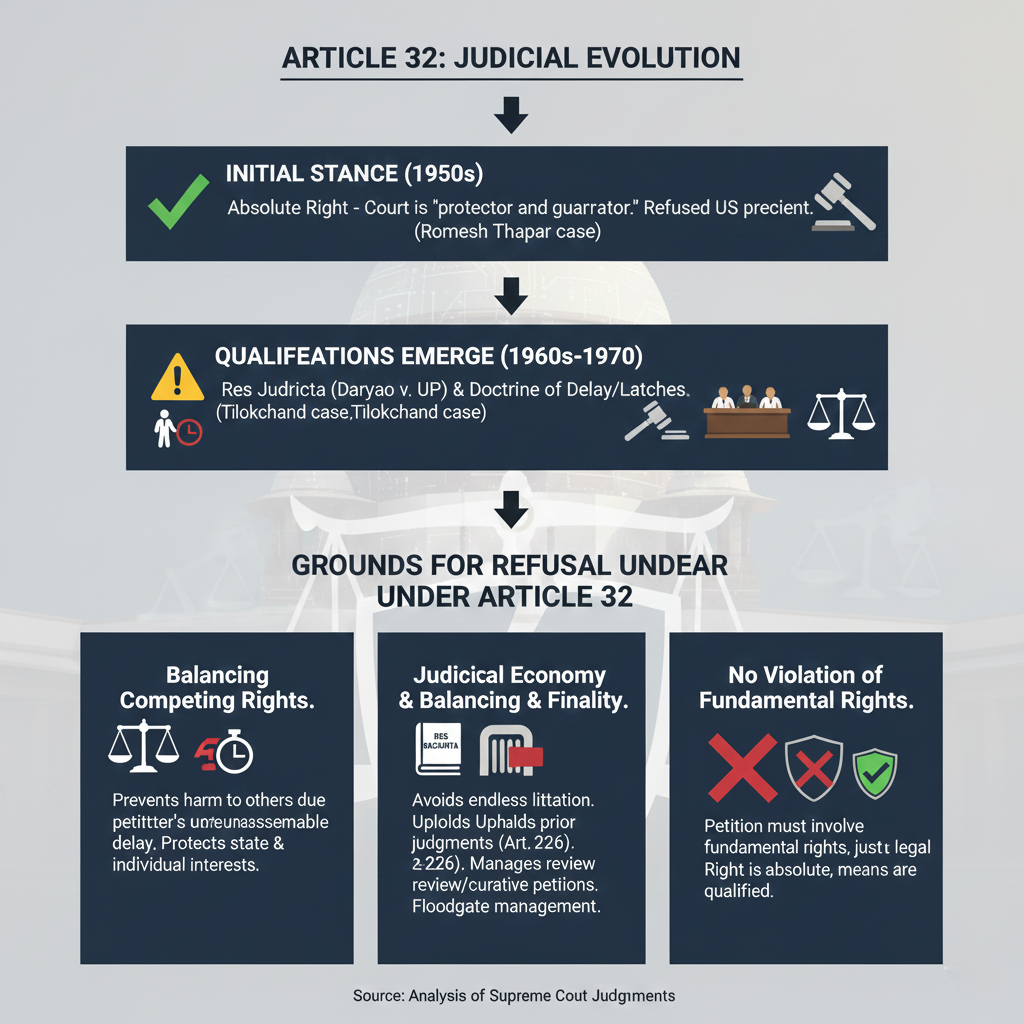
By analysing the trail of judgments around Article 32, we can narrow down the reasons on which the court relies to deny relief to the following:
Balancing competing rights
Courts introduced the restriction of delay/latches to protect the rights of others that might be harmed by the petitioner’s unreasonable delay. In the Tilokchand Case, the rights of the state were weighed against the rights petitioner, and it was held that the petitioner had no justifiable cause for the delay, so the court couldn’t punish others for the slumber of one.
Judicial economy and finality
To prevent endless litigation and conserve the resources of all stakeholders, the judiciary in the Daryao case held that if a high court has decided a case on merit under Article 226, it will be treated as res judicata, and a fresh petition under Article 32 will not be allowed.
Furthermore, one of the main reasons for qualifying Article 32 was to prevent the floodgates of countless review petitions and curative petitions from being opened. Accordingly, the court created a procedure in which the review petition must be reviewed by at least 3 judges before being tried, creating a safety buffer.
Not a violation of fundamental rights
Often, petitions under this article are denied because they fail to meet the requirements stated in the section. If someone approaches the SC with merely a wrong or a violation of a legal right, their petition automatically declines.
“The rights under Article 32 are absolute, and only the means to get there are qualified.” Meaning, if your fundamental right is violated, there is an absolute right to remedy available, but you must be mindful of the process through which these remedies are claimed.
Is the Refusal Reasonable?
To decide whether the refusal of relief under Article 32 is constitutional, the restrictions created by the Court itself must be tested on the same standards that courts apply while examining the validity of laws made by the legislature. Two such standards are relevant here: reasonable classification and the doctrine of proportionality.
Reasonable Classification
Under Article 14, any classification must satisfy two conditions. First, there must be an intelligible differentia, and second, this differentia must have a rational connection with the object sought to be achieved.
When courts refuse relief under Article 32 on grounds such as delay, res judicata, or abuse of process, they are not acting arbitrarily. The Court’s distinction is between petitioners who approach it in a timely and genuine manner to enforce fundamental rights and those who attempt to reopen issues that have already been decided or raise stale claims.
This distinction is reasonable because it is based on the conduct of the petitioner and not on any personal characteristic. The objective behind such classification is to ensure finality in litigation, protect the rights of others that may arise due to delay, and prevent misuse of the Court’s extraordinary jurisdiction. There is, therefore, a clear connection between the classification and the purpose it seeks to serve.
Doctrine of Proportionality
The doctrine of proportionality requires that any restriction on a right must pursue a legitimate objective, must use reasonable means, and must not impose excessive hardship.
The objective behind refusing relief under Article 32 is to maintain judicial discipline and prevent endless litigation. This objective is clearly legitimate. The means adopted by the Court, such as applying res judicata, rejecting petitions filed after unreasonable delay, and limiting repeated challenges through review and curative petitions, are also reasonable. These measures do not take away the right under Article 32 altogether; they only regulate the manner in which it is exercised.
Most importantly, the impact of such refusal is proportionate. The Court does not completely shut the doors of Article 32. It only refuses relief in cases where granting it would disturb settled legal positions or harm the rights of others. The right to approach the Court remains intact, but its misuse is curtailed.
In this sense, the refusal of relief under Article 32 does not amount to a denial of fundamental rights. Rather, it ensures that this powerful remedy is used responsibly and only in cases where there is a genuine violation of fundamental rights.
Conclusion
Article 32 occupies a special place in the Constitution. By making the right to move the Supreme Court itself a fundamental right, the framers ensured that the protection of fundamental rights would not depend on legislative grace or executive will. This is why Article 32 has often been described as the heart and soul of the Constitution.
At the same time, constitutional practice has shown that an unrestricted use of Article 32 can create serious problems. If every settled issue could be reopened, or if stale claims were allowed without explanation, the Court would be forced to revisit matters endlessly. This would not only burden the judiciary but also harm the rights of others that may have arisen due to the passage of time or prior adjudication.
The Supreme Court’s approach reflects an attempt to balance these concerns. While it has consistently protected the core of Article 32 and resisted attempts to dilute it, it has also evolved limited grounds on which relief may be refused. Principles such as res judicata, delay, and finality do not take away the right under Article 32; they only regulate the manner in which this right is exercised.
Therefore, Article 32 guarantees a remedy for genuine violations of fundamental rights, but it does not guarantee repeated opportunities to litigate the same issue. The refusal of relief in appropriate cases does not undermine the constitutional promise of Article 32. Instead, it helps preserve its seriousness and ensures that this extraordinary remedy remains effective, meaningful, and fair.