
Criminalization of Politics: Why Criminal Law Fails to Keep Alleged Criminals Out of Parliament
Introduction
In the Lok Sabha, the share of MPs facing serious criminal cases has more than doubled, from 14% in 2009 to 31% in 2024, as shown in the chart below. In the Assemblies, the share was 29% in 2024, which accounts for more than 1,200 MLAs. This leap raises the question of what incentives the system has to keep these alleged criminals in parliament. But first, it is important to understand how this problem began.
Laws that keep criminals “out” of politics
Criminalisation of politics refers to the involvement or direct participation of people with criminal backgrounds in electoral politics; simply put, more and more criminals are directly contesting elections. While discussing laws that disqualify parliamentarians, we focus solely on criminal disqualification and sidestep defection under the 10th Schedule
The principal law governing disqualifications from the Houses in India is the Representation of the People Act, 1951. However, this law derives its power from the constitution, which states, under Article 102 for MPs and Article 191 for MLAs, that “A person shall be disqualified if he is disqualified under any law made by Parliament.”
The Constituent Assembly debates show that the framers deliberately allowed Parliament to legislate additional disqualifications. Some members opposed this, fearing misuse, but the provision was retained to allow democratic lawmaking while safeguarding against arbitrary executive removal of representatives. In furtherance of constitutional intent, Parliament framed the RPA, clearly outlining the offences that can lead to disqualification, as well as the procedure for revoking membership. However, they were aware of and cautious about the abuse of this Act if disqualification were allowed merely on accusation, so, to preserve the representation of the people, they allowed disqualification only on conviction. They operated under the assumption that courts would work promptly and that convictions would be swift, both of which eventually proved to be wrong.
Loophole in safety rails
Under the Representation of the People Act, 1951, criminal disqualification is mainly governed by Section 8. The law follows a graded approach. Sections 8(1) and 8(2) provide for immediate disqualification upon conviction for certain serious offences, such as electoral offences, bribery, corruption, promoting enmity, and offences relating to dowry or immoral trafficking, without requiring any minimum sentence. Section 8(3), on the other hand, applies to all other criminal convictions and triggers disqualification only if the sentence awarded is two years or more. This structure shows that Parliament intended to keep persons convicted of serious offences out of legislatures, while also protecting against misuse by ensuring that only judicially determined guilt leads to disqualification.
However, this system depended heavily on the assumption that criminal cases would be decided within a reasonable time. As criminal trials became increasingly slow, this assumption began to fail. Conviction-based disqualification lost its practical effect because many cases did not even reach the stage of conviction during an entire electoral term. Furthermore, the RPA didn’t stipulate any time limit for the courts to abide by. What was meant to be a safeguard against false accusations slowly turned into a loophole that allowed accused candidates to remain in politics indefinitely.
This problem deepened with changes in the nature of electoral politics. Over time, money, power and muscle power became electorally valuable assets. Candidates who could finance expensive campaigns, mobilise local influence, or display strength on the ground were seen as “winnable,” even if they had serious criminal cases pending against them. Political parties, driven by the pressure to win elections, increasingly preferred such candidates over those with clean records but fewer resources.
Once such individuals entered the political system, they gained further advantages. With access to money, influence, and local authority, they were often able to delay the criminal process itself. The framing of charges could be postponed through repeated adjournments, procedural objections, or lack of effective prosecution. In many cases, witnesses were influenced, intimidated, or turned hostile, making convictions even less likely. As a result, criminal trials dragged on without conclusion, allowing accused legislators to continue contesting elections and holding office.
This situation was worsened by Section 8(4) of the RPA, which earlier allowed sitting MPs and MLAs to retain their seats for three months after conviction, and even beyond if they filed an appeal. Although this provision was later struck down by the Supreme Court in Lily Thomas v Union of India (2013), its existence revealed how the law had adjusted to protect incumbents once criminalisation within legislatures became widespread.
Some corrective steps were taken later, including the removal of special protection under Section 8(4), the establishment of fast-track courts for cases involving MPs and MLAs, and the mandatory disclosure of criminal antecedents during elections. However, these measures addressed only part of the problem. The central loophole remains unchanged: a system that relies on conviction cannot work effectively when convictions are routinely delayed. Over time, the safety rails designed to keep criminals out of politics were not dismantled, but gradually bent, allowing money, muscle, and delay to overpower criminal law without openly defying it.
Vested interest behind the Loopholes
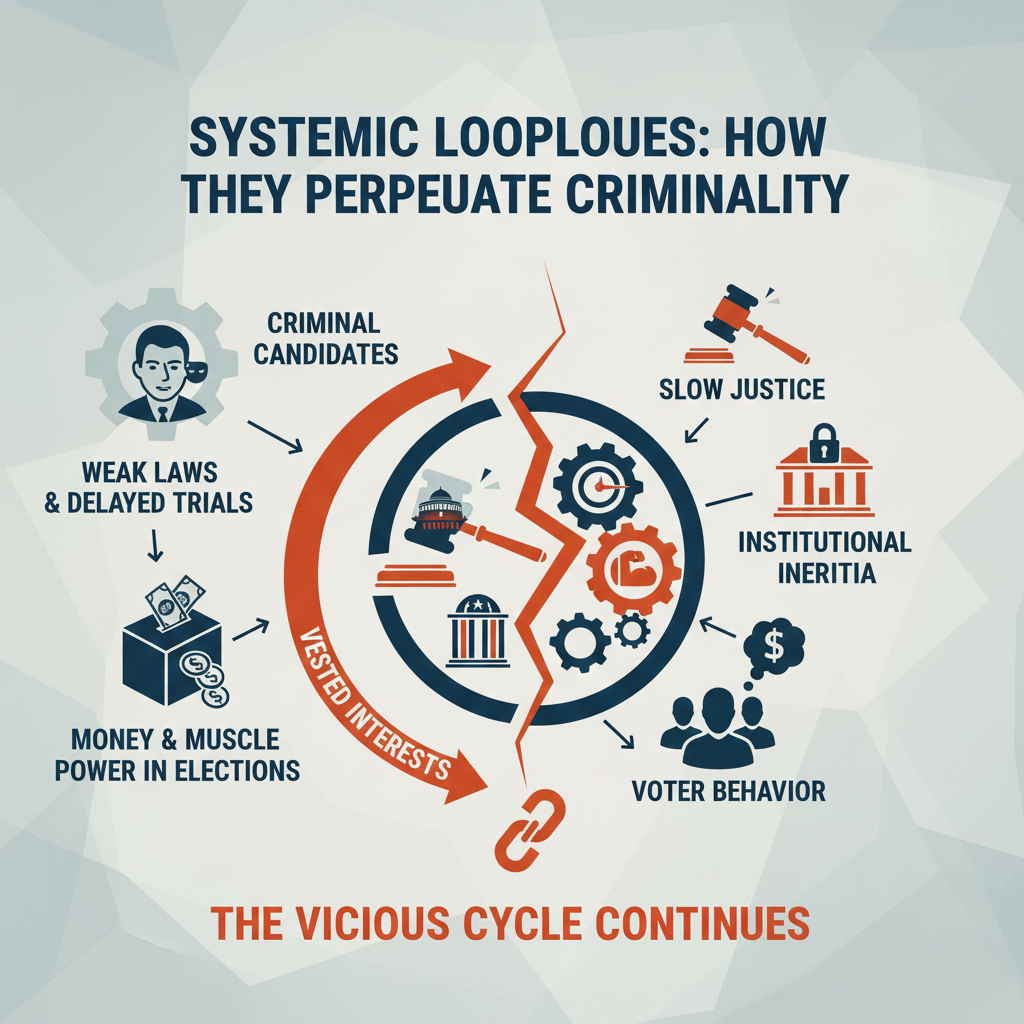
The continued presence of individuals accused of crimes in legislatures cannot be explained solely by weak laws or delayed trials. It is sustained by a wider set of vested interests across the system, many of which operate quietly and are rarely discussed. While political parties do benefit from such loopholes, the deeper reasons lie beyond party strategy.
At the political level, the incentive is straightforward. Parties often prioritise electoral winnability over ethical considerations. Candidates with money, influence, and local control are seen as reliable vote-getters, especially in competitive elections. Criminal cases, as long as they remain pending, do not legally disqualify such candidates and therefore do not disrupt electoral calculations. However, this explanation alone is incomplete.
A more complex and uncomfortable dimension lies with voters themselves. In many constituencies, voters do not necessarily see criminal cases as a disqualifying factor. Instead, they often value accessibility, strength, and the ability to solve problems immediately. A candidate with a reputation for being “strong” may be preferred because they can intervene in local disputes, influence officials, or secure benefits quickly. In areas where public institutions are weak or slow, such informal authority becomes attractive. Over time, this creates a social tolerance for criminality in politics, where effectiveness is prioritised over legality.
There is also an economic aspect to voter behaviour. Some voters rely on local leaders for short-term material benefits, employment opportunities, or protection. Criminally influential politicians often operate as informal welfare providers, filling gaps left by the state. This creates a relationship of dependence rather than accountability. As long as these expectations persist, criminal law alone cannot reshape electoral choices.
Institutional actors also have indirect stakes. The criminal justice system, already burdened with heavy pendency, is structurally ill-equipped to prioritise cases involving powerful political figures. Delay becomes routine rather than exceptional. Since there are no direct consequences for prolonged trials, institutional inertia quietly supports the status quo. Predictable delay makes conviction-based disqualification ineffective in practice.
Law enforcement agencies face similar constraints. Investigating politically powerful individuals often involves professional risk, transfers, or pressure. Even without overt misconduct, this environment discourages assertive investigation. As a result, cases move slowly, witnesses turn hostile, and prosecutions weaken over time.
Even the legislature as an institution has an interest in stability. Frequent disqualifications would trigger by-elections, disrupt legislative functioning, and create political uncertainty. Since many legislators are themselves affected by the same legal framework, reform requires a level of self-restraint that is difficult to expect in competitive politics.
Finally, the judiciary, while independent, operates within constitutional limits. Courts are cautious about disqualifying representatives at the stage of accusation, mindful of the presumption of innocence and the risk of political misuse of criminal law. This restraint is principled, but it also means that courts intervene only after damage has already occurred.
Together, these overlapping interests ensure that the criminalisation of politics is not actively resisted by the system. Each stakeholder gains something—electoral success, social control, institutional convenience, or stability, while the long-term cost is borne collectively in the form of weakened criminal accountability and declining public trust. When such interests align across society and institutions, reform cannot rely solely on the law.
Rectifying the loopholes
The failure of criminal law to keep criminals out of legislatures shows that the problem is not the absence of law, but the environment in which the law operates. Simply lowering thresholds for disqualification or introducing harsher legal consequences is unlikely to work. Such measures risk misuse and do not address the deeper forces that make criminal candidates electorally attractive in the first place. Meaningful reform, therefore, must focus on changing incentives across the system, not merely rewriting statutes.
A key area of intervention is money power in elections. Criminal influence thrives in a political environment where election campaigns are expensive and poorly regulated. When winning an election depends heavily on private financing, candidates with access to illegal or informal funds gain a natural advantage. Stricter enforcement of spending limits, transparent funding mechanisms, and greater public financing of elections can reduce this imbalance. When money matters less, criminal backgrounds lose much of their electoral value.
Equally important is the social demand for “strong” leaders. Many voters turn to criminally influential politicians not out of ignorance, but out of necessity. Weak public services, delayed welfare delivery, and unresponsive administration create conditions where informal power becomes attractive. Improving basic education, healthcare, employment security, and welfare delivery reduces this dependence. When citizens can rely on institutions rather than individuals, the appeal of criminal intermediaries declines.
Closely linked to this is the need for effective grievance redressal mechanisms. In many areas, criminal politicians function as problem-solvers because the formal system is slow or inaccessible. Strengthening local governance, policing, and administrative complaint systems can ensure that citizens do not have to seek protection or justice through extra-legal means. A system that listens and responds leaves little space for criminal authority.
Reform is also required within the criminal justice system itself. Conviction-based disqualification can only be effective if trials are concluded within a reasonable timeframe. This requires strict and enforceable timelines, particularly in cases involving elected representatives. Rather than extraordinary powers, the focus should be on procedural discipline—limiting adjournments, prioritising framing of charges, and ensuring witness protection. Speedy justice not only strengthens criminal law but also restores its deterrent effect in politics.
Ultimately, the goal should not be to mechanically disqualify more candidates, but to create conditions where criminal candidates are no longer viable or desirable. When elections are affordable, voters are empowered, institutions are responsive, and courts are timely, criminality loses its strategic advantage. Only then can criminal law reclaim its role as a meaningful safeguard rather than a symbolic one.
Conclusion

The persistence of criminalisation in Indian legislatures is not the result of a missing legal framework. The Constitution and the Representation of the People Act were intentionally designed to strike a balance between electoral integrity and the presumption of innocence by tying disqualification to conviction rather than accusation. However, this design rested on an assumption of timely criminal justice. As trials slowed and political incentives changed, conviction-based disqualification lost its force, turning a constitutional safeguard into a practical loophole.
Criminal law alone cannot correct outcomes produced by expensive elections, social acceptance of “strong” leadership, weak public institutions, and routine judicial delay. Reform, therefore, lies less in tightening legal thresholds and more in reshaping the system that rewards criminality, by reducing the role of money in elections, strengthening public services and grievance redressal, and ensuring timely trials. Only when these conditions change will criminal law function as an effective filter rather than a symbolic restraint.