
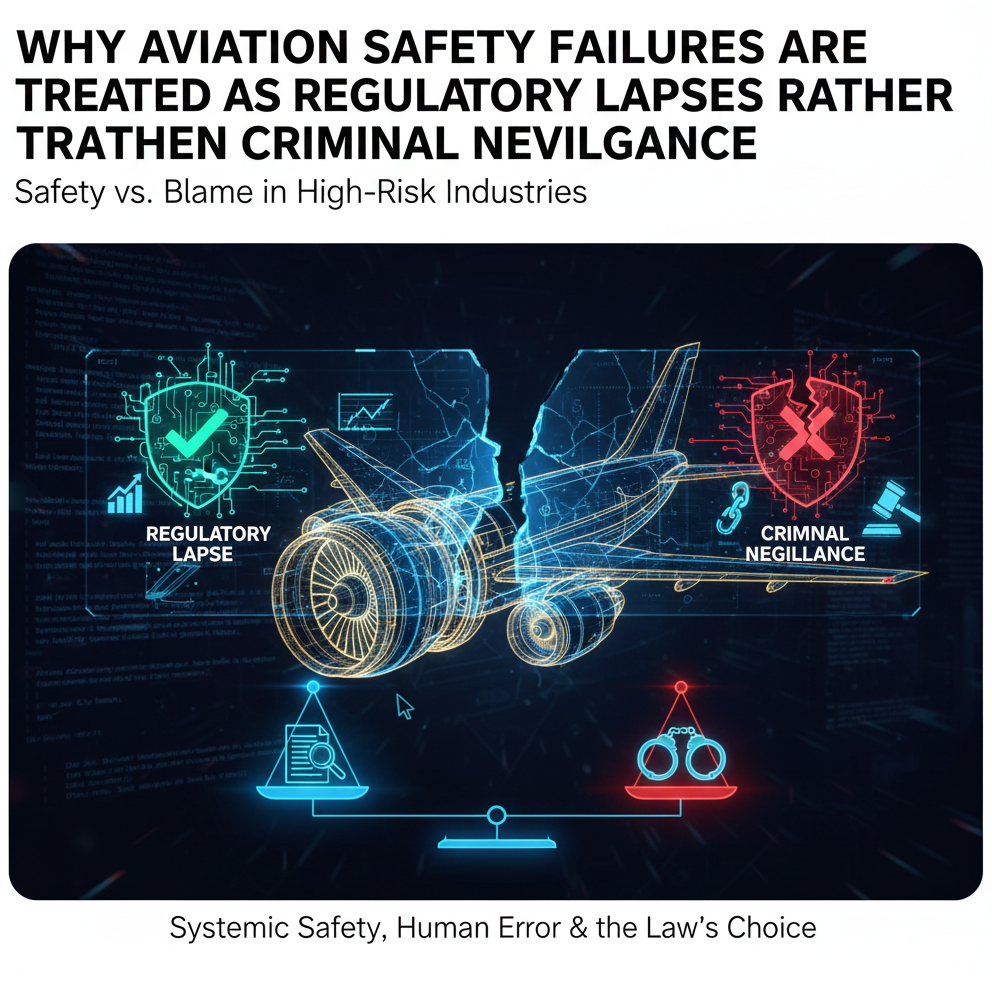
Aviation Safety Regulation vs Criminal Negligence: Why Aviation Safety Failures Are Treated As Regulatory Lapses Rather Than Criminal Negligence
Introduction
Aviation safety failures often appear, at first glance, to be textbook cases of criminal negligence. A missed maintenance check, a procedural deviation in the cockpit, or a decision taken under pressure that later proves fatal all appear to satisfy the basic intuition behind criminal responsibility. Harm has occurred, lives may be lost, and someone clearly made a mistake. In most areas of law, that sequence would naturally trigger criminal scrutiny.
Yet aviation law resists this instinct. Even in cases involving serious injury or death, the legal response usually remains regulatory rather than criminal. Investigations focus on identifying systemic weaknesses instead of assigning personal blame. This raises a central question: why does the law consistently choose regulation over criminal negligence when the consequences are so severe?
What Difference Will It Make?
The difference between treating a safety failure as a regulatory lapse rather than a criminal offence is not merely semantic. Criminal law is punitive; it looks backwards to identify blame and impose punishment. Regulatory law, on the other hand, is forward-looking. Its primary concern is not moral condemnation, but risk reduction and future compliance.
This distinction is important because the type of punishment involved is fundamentally different. Criminal punishment carries stigma, incarceration, and lasting consequences for personal liberty. Regulatory sanctions, such as fines, licence suspensions, corrective directives, or grounding of aircraft, aim to correct behaviour without destroying the information ecosystem on which safety depends. In aviation, where learning from mistakes is critical, the law deliberately prefers mechanisms that encourage disclosure over those that incentivise silence.
Labels matter because they shape behaviour. Calling an act “criminal” changes how individuals respond to investigations, how organisations record errors, and how risks are reported internally. The regulatory label signals that the objective is improvement, not retribution. That choice is not accidental; it reflects a conscious legal prioritisation of systemic safety over individual punishment.
Provisions of Aviation Law
Aviation law does not completely exclude criminal liability. Rather, it places it at the margins. The legal framework primarily relies on regulatory oversight exercised by aviation authorities, while criminal negligence is reserved for exceptional circumstances. These include situations involving wilful misconduct, reckless disregard for safety norms, intoxication, or deliberate violations of mandatory procedures.
In ordinary safety failures, where errors arise from misjudgement, fatigue, miscommunication, or complex operational environments, the law stops short of criminalisation. This selective approach answers an important question: yes, criminal negligence is legally possible, but it is intentionally rare. The framework is designed to distinguish between systemic error and culpable wrongdoing, ensuring that criminal law is triggered only when moral blameworthiness is clearly established.
Why regulatory lapse rather than criminal negligence
The central reason why safety failures are treated as regulatory lapses rather than criminal negligence is that there is no clear proof of mens rea. In almost all cases, it can’t be proved that the pilot or any other crew member had an intention to cause the fault, even when the fault resulted in grave harm. Unlike any other wrong, there is rarely proof of the level of blameworthiness that criminal law demands, even in cases of serious harm. Additionally, the accident is often caused by multiple factors, further complicating the issue of clear intent.
Secondly, we attach criminal consequences to unintentional acts; employees who might contribute to the investigation may hesitate to speak up, fearing that the information might be used against them. The primary focus of an investigation into safety failures is to determine the reason behind the accident and help prevent similar accidents in the future. This is where the idea of just culture comes in; it promotes an environment where there is constant learning from the free flow of information. By not assigning blame to a person, the law promotes future safety.
Thirdly, there is the question of rights. The law provides a right against self-incrimination under Article 20 of the Indian Constitution. Gathering or using information from employees raises serious concerns under the right against self-incrimination. Even if a case is made based on this information, it may not be admissible in court, rendering the whole procedure redundant.
Fourthly, arguments for vicarious corporate liability are made using the “collective knowledge” doctrine. This assumes that the corporation has complete knowledge of all its activities. It is essential to note that the collective knowledge doctrine applies only to a corporation’s knowledge. It does not address the element of specific intent. And this is exactly why this doctrine fails in the case of crime, which requires mens rea.
Lastly, and most importantly, using criminal laws in case of safety failures defeats the purpose of criminal punishment itself. The major theories of criminal punishment consist of prevention, restraint, rehabilitation, deterrence, education, retribution, and restoration. If we hold these against safety failures, all of them either fail or don’t apply.
The purpose of prevention is to convince the criminal actor that committing future crimes is not in their best interest. This is defeated as there is no intent to commit a crime in the first place. Under the theory of restraint, society seeks to protect itself from someone deemed dangerous. This falls apart because there is no base or triggering conduct that can properly be classified as criminal, absent the mens rea component.
Rehabilitation aims to reform criminal behaviour through treatment that eliminates the internal desire to commit crimes. For it to work, the wrongdoer must have a persistent urge to offend. Isolated acts labelled as pilot error do not indicate a repetitive desire for reform. Under deterrence theory, punishing criminals mainly aims to influence society. It’s designed to deter similar offenders from future crimes by showing that conformity prevents punishment. This is effective because it adds to other law-abiding forces. Regarding pilot error, the key question is: “Does punishing a crew member prevent future similar errors?” The answer is no. Many writings on “just culture” in aviation show that criminalising pilot error does not stop crew members from repeating errors.
All of these clearly illustrate why criminal laws should not be used while dealing with safety failures. However, all of these arguments fall apart if mens rea is proven. That’s why it must be essential to use criminal negligence when there is clear proof of foul play or intention to cause harm.
Conclusion
Aviation law’s preference for regulatory treatment over criminal negligence is not an act of leniency; it is a structural choice. The law recognises that in high-risk industries, safety depends less on punishment and more on transparency, learning, and institutional correction. Criminal law, with its focus on blame and deterrence, is a blunt instrument when applied to complex systems where failure is rarely the result of a single wrongful intent.
That restraint, however, is not unconditional. Where clear evidence of mens rea, foul play, or reckless disregard exists, the justification for regulatory tolerance collapses. In such cases, criminal negligence is not only appropriate but necessary. The balance of aviation law strikes is therefore deliberate: protect the safety system first, punish only when blame is undeniable.


Pingback: Why Implement Potentially Unconstitutional Laws: When the Executive Implements Laws It Knows Are Unconstitutional - elementlex.com