

Women’s Rights and Legal Safeguards in India

Abstract
Gender equality is a fundamental principle and a crucial tool that ensures everyone can exercise their rights, duties, and responsibilities freely and without coercion. It plays a crucial role in protecting women’s rights, which is vital for the development of a democratic society like India. The Indian legal system recognises the importance of protecting women’s rights and provides various mechanisms to safeguard them. The Constitution of India, in particular, offers several protections against discrimination, violence, and exploitation. However, the gap between legal safeguards and ground reality remains a serious concern. This article highlights the persistent challenges faced by women in society and emphasises the need for effective enforcement, legal awareness, and institutional mechanisms that can transform legal rights into actual empowerment through social awareness and meaningful implementation.
Introduction
The position of women in Indian society has historically been shaped by patriarchal norms, social customs, and economic dependence. Although women in ancient India enjoyed a certain degree of social respect and participation, they were still denied full freedom and rights due to restrictive traditions, limited access to education, and the absence of property and decision-making rights.
The principle of gender equality is enshrined in the Indian Constitution through various Fundamental Rights, Duties, and Directive Principles that aim to empower women. While significant progress has been achieved through legislative and judicial interventions, gender inequality remains a persistent challenge. This article examines the constitutional provisions, statutory safeguards, and international obligations governing women’s rights in India, and analyses the challenges in their effective implementation in the pursuit of genuine gender justice.
Constitutional Framework for Women’s Rights
The Constitution of India provides a comprehensive framework for women’s empowerment. It seeks to ensure gender equality and empower women across different stages of life. These provisions are designed to protect women from discrimination, promote their well-being, and secure their equal participation in political, economic, and social spheres.
Key constitutional provisions for women’s empowerment:
A. Fundamental Rights
Article 14
Article 14 guarantees the right to equality to every citizen and provides that the State shall not deny to any person equality before the law or equal protection of the laws within the territory of India.
Articles 15(1) and 15(3)
Article 15(1) prohibits discrimination by the State on grounds of religion, race, caste, sex, or place of birth. Article 15(3) empowers the State to make special provisions for women and children.
Article 16
Article 16 guarantees equal opportunities for all citizens in matters relating to employment or appointment to any office under the State.
B. Directive Principles of State Policy
Articles 39
Article 39(a) directs the State to ensure that all citizens, both men and women, have the right to an adequate means of livelihood.
Article 39(d) mandates equal pay for equal work for both men and women.
Article 39A requires the State to ensure that the legal system promotes justice based on equal opportunity and provides free legal aid so that justice is not denied due to economic or social disadvantages.
Articles 243D(3), 243D(4), 243T(3), and 243T(4)
These provisions mandate the reservation of one-third of the total seats to be filled by direct election in every Panchayat and Municipality for women. They also require that one-third of the offices of Chairpersons at each level of Panchayats and Municipalities be reserved for women.
Article 51A
Article 51A sets out the Fundamental Duties of every citizen. Although these duties are not directly enforceable by courts, they play an important role in fostering a responsible, inclusive, and egalitarian society.
Promise vs. Reality
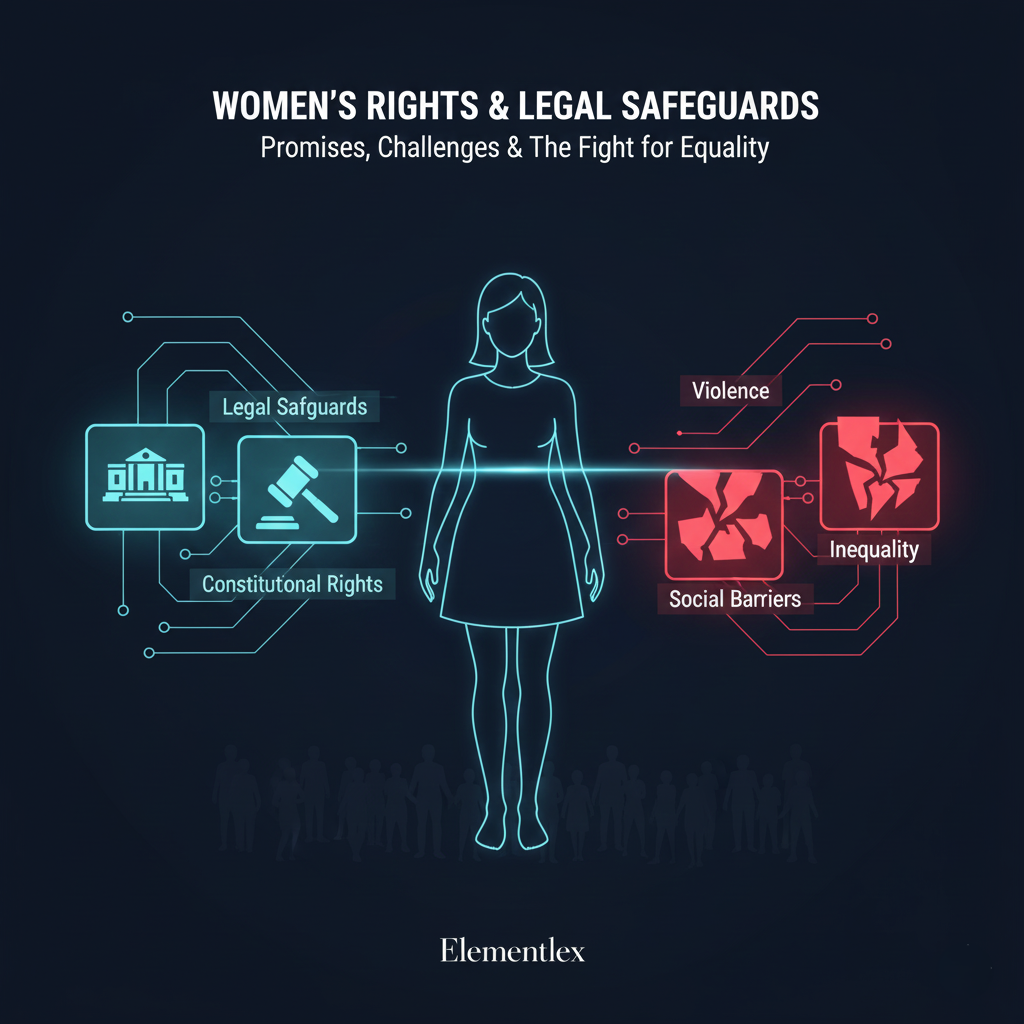
The Indian Constitution lays a strong normative foundation for the protection of women’s rights through its various provisions. However, their effectiveness remains uneven due to weak implementation, lack of legal awareness, and persistent social stigma that discourages women from seeking remedies.
Despite this progressive legal architecture, constitutional guarantees often remain aspirational rather than transformative, as reflected in the lived realities of women across India. For instance, although Article 21 guarantees the right to live with dignity, incidents of custodial violence, domestic abuse, and sexual assault continue to be reported at alarming rates, particularly among women from marginalised and rural communities.
Similarly, while Articles 14 and 16 promise equality and equal opportunity, women’s participation in the workforce remains disproportionately low, especially within the informal sector where constitutional safeguards are the weakest. Despite the constitutional mandate of equal pay for equal work under Article 39(d), wage disparities persist, pointing to failures of enforcement rather than an absence of legal norms.
Unequal access to education and high dropout rates among girl children further illustrate how constitutional morality has struggled to penetrate entrenched patriarchal structures. Collectively, these realities demonstrate that legal recognition alone cannot secure substantive equality. Meaningful transformation requires sustained state accountability, gender-sensitive governance, and a broader societal commitment to internalising constitutional values beyond mere textual compliance.
These examples underline that while the Constitution and the judiciary have consistently advanced women’s rights in principle, structural inequality, weak enforcement, and patriarchal social norms continue to limit their transformative impact. Constitutional morality must therefore move beyond courtrooms and statutes to become a lived social reality through effective governance and societal change.
Statutory Legal Safeguards for Women
To protect women from discrimination, violence, and exploitation, the Indian legislature has enacted several specialised laws aimed at safeguarding equality and dignity. Some of the key statutes are outlined below:
The Immoral Traffic (Prevention) Act, 1956
This Act seeks to prevent trafficking for commercial sexual exploitation and to protect women and girls from being forced into prostitution. It criminalises activities such as running brothels, living on the earnings of prostitution, and procuring or detaining persons for such purposes. The Act aims to safeguard the dignity of women and curb organised exploitation.
The Dowry Prohibition Act, 1961 (as amended in 1986)
The Dowry Prohibition Act prohibits the giving, taking, or demanding of dowry in connection with marriage. The 1986 amendment strengthened the law by enhancing penalties and expanding its scope to include indirect demands. The Act seeks to eliminate dowry-related harassment, cruelty, and deaths, thereby protecting women from economic exploitation within marriage.
The Commission of Sati (Prevention) Act, 1987
This legislation was enacted to completely prohibit the practice of sati and its glorification. It criminalises not only the act itself but also any encouragement, support, or celebration of the practice. The Act reflects a strong commitment to protecting women’s right to life and dignity and to eradicating harmful traditional practices.
The Protection of Women from Domestic Violence Act, 2005
This Act provides civil remedies to women facing abuse within domestic relationships. It recognises physical, emotional, sexual, and economic abuse and offers relief such as protection orders, residence rights, maintenance, and compensation. The law focuses on providing immediate and effective protection to women within the household.
The Sexual Harassment of Women at Workplace (Prevention, Prohibition and Redressal) Act, 2013
This Act seeks to ensure a safe and dignified working environment for women. It mandates the establishment of Internal Complaints Committees and Local Complaints Committees to address complaints of sexual harassment. Applicable to both organised and unorganised sectors, the law focuses on prevention, prohibition, and effective redressal of workplace harassment.
Role of the Judiciary and Landmark Judgments
The Indian judiciary has played a crucial role in advancing women’s rights by adopting a gender-sensitive approach and expanding constitutional protections to uphold equality and dignity.
Delhi Domestic Working Women’s Forum v. Union of India (1995)
The Supreme Court held that rape constitutes a grave violation of a woman’s right to life and dignity under Article 21. The Court directed the State to provide compensation, legal assistance, and rehabilitation to victims of sexual violence, and recommended the establishment of Criminal Injuries Compensation Boards, thereby adopting a victim-centric approach to justice.
Vishakha v. State of Rajasthan (1997)
In this landmark judgment, the Supreme Court laid down the Vishakha Guidelines to prevent sexual harassment at the workplace and recognised sexual harassment as a violation of fundamental rights under Articles 14, 15, 19, and 21. These guidelines later formed the foundation of the Sexual Harassment of Women at Workplace (Prevention, Prohibition and Redressal) Act, 2013.
Budhadev Karmaskar v. State of West Bengal (2011)
The Supreme Court affirmed that sex workers are entitled to live with dignity under Article 21 of the Constitution. The Court acknowledged that prostitution is often driven by poverty and social circumstances, and directed the State to focus on rehabilitation and reintegration rather than criminalisation.
Aureliano Fernandes v. State of Goa and Others (2023)
The Supreme Court strengthened the implementation of the Sexual Harassment of Women at Workplace Act, 2013, by issuing mandatory directions to ensure effective compliance. The Court emphasised the compulsory constitution of Internal Complaints Committees (ICCs), awareness of the law, and adherence to time-bound inquiry procedures. The judgment reinforced women’s right to a safe and dignified working environment and underscored the responsibility of employers and the State in preventing workplace sexual harassment.
Maatr Sparsh: An Initiative by Avyaan Foundation v. Union of India (2025)
The Supreme Court recognised the right of nursing mothers to breastfeed their children and held that the State has a corresponding duty to facilitate this right by ensuring the availability of feeding rooms and childcare facilities in public places.
International Obligations and Women’s Rights
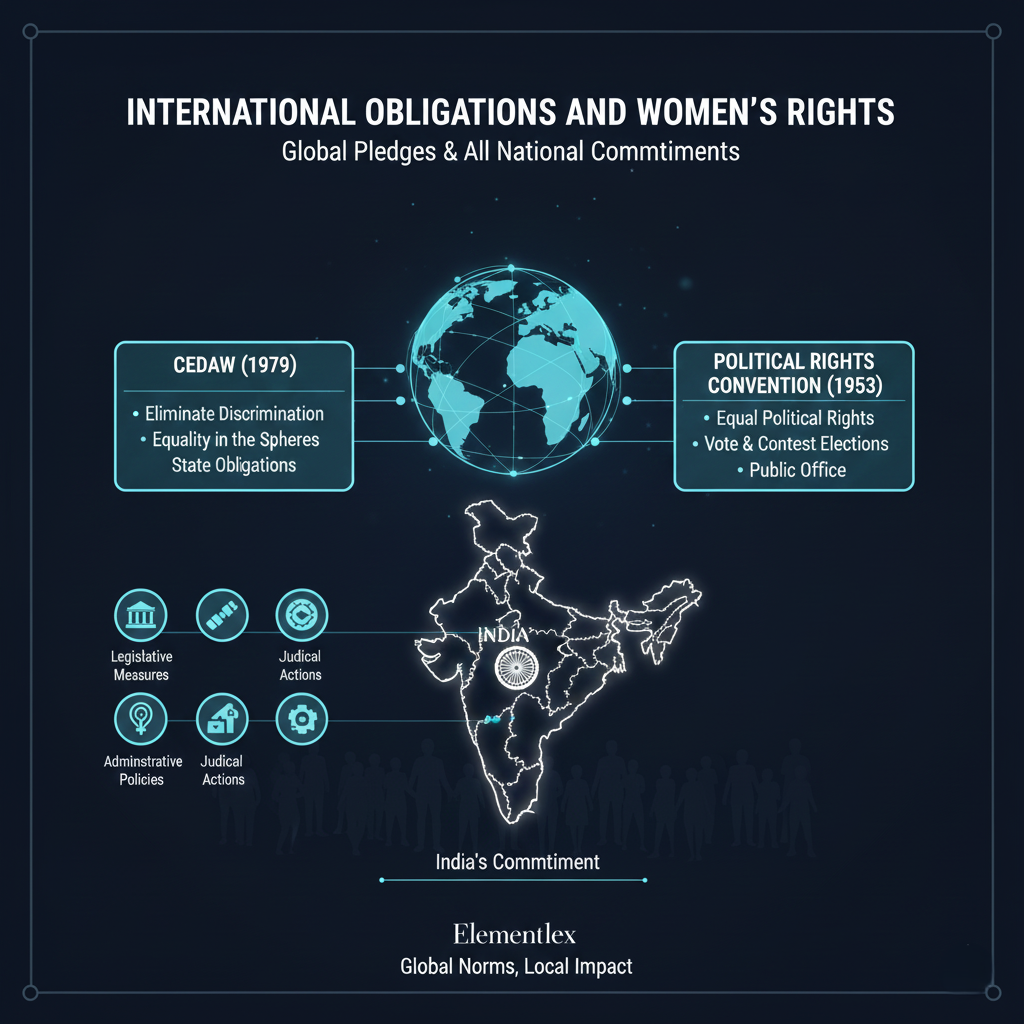
India’s commitment to protecting women’s rights extends beyond its domestic legal framework to the international sphere. As a signatory to several key international human rights instruments, India has undertaken obligations to eliminate discrimination against women and promote gender equality. The most significant among these is the Convention on the Elimination of All Forms of Discrimination Against Women (CEDAW), which requires State parties to adopt legislative, judicial, and administrative measures to ensure substantive equality for women.
Some of the key international instruments include:
Convention on the Elimination of All Forms of Discrimination against Women (1979)
This Convention aims to eliminate discrimination against women and ensure equality across all areas of life. It obligates States to adopt appropriate laws, policies, and measures to protect and promote women’s rights.
Convention on the Political Rights of Women (1953)
Adopted in 1953, this Convention recognises women’s equal political rights. It guarantees women the right to vote, contest elections, and hold public office on equal terms with men, without discrimination. The Convention seeks to ensure women’s full and effective participation in political and public life.
Challenges in Implementation
Women’s rights in India reflect a complex mix of significant legal progress and persistent societal and institutional challenges. While robust legal frameworks exist, their effective implementation remains a major hurdle.
Key challenges include:
- Gender-Based Violence
Despite legal protections, domestic abuse and sexual assault remain widespread. Many cases go unreported due to fear, social stigma, and a lack of trust in the justice system. Globally, nearly 30% of women who have been in a relationship have experienced physical and/or sexual violence by an intimate partner, and women continue to be disproportionately affected by sexual assault, including rape.
- Economic Disparity
Persistent wage gaps, underrepresentation in formal employment, and the disproportionate burden of unpaid care work continue to undermine women’s economic independence.
- Socio-Cultural Barriers
Deeply entrenched patriarchal attitudes, early marriages, and rigid gender stereotypes restrict women’s autonomy and decision-making power, particularly in rural and marginalised communities.
- The Unnao rape case illustrates several implementation failures:
- Intimidation and harassment of the victim and her family during investigation and trial, undermining their safety and access to justice.
- Prolonged debates over procedural technicalities and bail, demonstrating how legal processes can dilute the impact of stringent protections.
- Subsequent judicial interventions, including the Supreme Court’s stay on a High Court order granting bail, reflect the complexity of high-profile cases and the difficulty of balancing procedural safeguards with substantive justice.
These examples demonstrate that while India’s international commitments have shaped legislation and judicial reasoning, their practical impact remains constrained by weak enforcement, limited accountability, and inconsistent political will. Bridging this gap requires not only harmonising international norms with domestic law but also establishing measurable compliance mechanisms to ensure that global commitments translate into tangible improvements in women’s lived realities.
Suggestions and the Way Forward
Ensuring the effective protection of women’s rights requires more than the mere existence of laws. It demands sustained efforts in implementation, awareness, and societal support. Addressing existing gaps calls for coordinated action by the State, the judiciary, civil society, and individuals to translate legal safeguards into meaningful empowerment. Some key measures include:
- Strengthening legal awareness
NGOs, legal aid organisations, and educational institutions should conduct sustained awareness programmes to help women understand their rights and the remedies available to them.
- Role of individuals and leaders
Social reformers, women leaders, lawyers, teachers, and public influencers must actively challenge patriarchal attitudes and promote respect for women’s dignity and autonomy.
- Institutional responsibility
Police authorities, courts, and workplaces should adopt a gender-sensitive and victim-centric approach while handling complaints, ensuring fairness, sensitivity, and accountability.
The realisation of women’s rights ultimately depends on effective enforcement, social awareness, and collective responsibility. Only when strong legal frameworks are supported by responsive institutions and active community participation can genuine gender equality and empowerment be achieved.
Conclusion
The protection of women’s rights requires more than the existence of strong laws; it demands effective implementation and active participation from all sections of society. While the State and the judiciary provide the legal framework and remedies, NGOs, social reformers, community leaders, and individuals play a crucial role in raising awareness, supporting victims, and transforming social attitudes. True empowerment of women can be achieved only through collective responsibility, where law, society, and compassion work together to ensure equality, dignity, and justice in practice.
If you’re interested in how constitutional discretion and implementation gaps shape real outcomes, you may also want to read about the Governor’s Discretion

